
Peace of Mind in Your Pocket
Why I Never Travel Without a Medical Alert Card
Most travellers pack for the trip they hope to have.
They pack outfits, chargers, sunscreen, headphones, and backup shoes.
But they forget to pack for the ten minutes that could matter most.
The ten minutes when they cannot explain themselves.
The ten minutes when a stranger needs answers fast.
The ten minutes when a small card in a wallet can speak for them.
That is why I never travel without a medical alert card.
Not because I expect something bad to happen. Because I know what silence costs when it does.
After years of long-term prescriptions and what feels like a mountain of forms at the doctor, I eventually asked myself a simple question: if I couldn’t speak, would anyone around me know what to do? The honest answer was no. That’s when I sorted it.
The Person Who Thinks This Is Overkill
Picture Danielle.
She is healthy enough. She works full time. She travels a few times a year. She has a mild allergy, takes one daily medication, had surgery years ago. She keeps emergency contacts in her phone.
She does not think of herself as “the medical alert card type.” That is for people with serious conditions. For much older people. For people who need bracelets and warnings.
“I have my phone.”
“My travel insurance has my details.”
“I can just tell someone if anything happens.”
That last thought is the problem. It assumes she can speak. It assumes she is calm. It assumes the person helping her understands her. It assumes her phone is unlocked, charged, nearby, and easy to search.
Emergencies are not neat. They are fast, loud, confusing, and inconvenient. They do not wait until you are ready to explain.
The First Cost: Time
Imagine Danielle gets dizzy in a train station abroad. Maybe dehydration. Maybe an allergic reaction. Maybe something else.
People gather. Someone calls for help. Danielle tries to explain, but she is shaky. She cannot remember the local emergency number. She cannot recall the name of her medication under pressure. She cannot say with certainty whether her allergy matters here.
Without a medical alert card, every basic question becomes a search. Someone checks her bag. Someone tries her phone. Someone guesses which contact to call. Someone waits for translation.
The cost is not theoretical. It is minutes. And in a medical situation, missing minutes matter.
A good medical alert card cuts through that fog immediately. Name. Emergency contact. Conditions. Allergies. Medication. Blood type. Insurance. It does not solve everything, but it removes the guessing. And removing guessing is not a small thing.
The Second Cost: Mental Load
Travel is already full of tiny decisions. Which platform? Which gate? Which taxi? Which direction? You may not feel the weight at first. Then you land tired, hungry, hot, and overstimulated.
Now add medical uncertainty. A quiet background worry that sits under the trip like a low battery warning. What if my medication gets lost? What if I react to something? What if nobody knows who to call?
A medical alert card gives that worry a place to live. Not in your head. In your wallet. Peace of mind is not only about feeling safe — it is about freeing your mind for the actual trip. The cold drink. The chat with the girls. The sunset you came all this way to see.
The Third Cost: Phone Dependence
Danielle trusts her phone. Most of us do. Contacts, notes, insurance apps, health records. That sounds smart — until the phone becomes the weak link.
Phones die. Phones lock. Phones break. Phones get stolen. Phones lose signal. A paramedic may not have time to explore your screen. A bystander will not know your passcode. Your phone may be in your hotel room, not your pocket.
A medical alert card has one job. It sits there. No battery. No signal. No app update. No password. Anyone can read it. Anyone can hand it to a doctor, nurse, guide, hotel worker, or police officer. That simplicity is the point. Sometimes the smartest tool is still something you can hold in your hand.
The Fourth Cost: Miscommunication
Danielle has a penicillin allergy. At home, that fact sits safely in her medical file. Her doctor knows. Her pharmacy knows. Her partner knows.
But abroad, nobody knows unless she can say it. And if she is stressed, in pain, and exhausted in a foreign clinic — the word may not come. The accent may be unclear. The room may be noisy. The local name for the drug may differ.
A medical alert card puts the facts in writing. The critical words, ready before you need them. That is the difference between preparation and panic.
The Fifth Cost: Burdening Other People
If something happens to Danielle, her family may get a call with almost no context. A hotel worker may have to search her room. A tour guide may have to answer questions they cannot answer. Her family may spend hours calling airlines, hospitals, hotels, and insurers.
Not because they do not care. Because the information was scattered. Some in her phone. Some in her email. Some in her memory. Some nowhere useful.
A medical alert card is an act of kindness. It says “here is what you need” — and lowers the burden on people who may already be scared.
The Sixth Cost: Money
Nobody likes to talk about money during medical planning. But confusion gets expensive fast. Not always because of the treatment itself — sometimes because of delay, duplicated steps, or nobody knowing your insurance details.
Danielle may not carry her insurer’s emergency number. She may assume it is in her email. But now she has no Wi-Fi. Or her phone is dead. Without clear details, decisions slow down and get messier. A medical alert card with your policy number and emergency assistance line gives the process fewer ways to fail.
The Seventh Cost: Avoidance
This is the cost nobody sees. Some people avoid travel because of health concerns. They say they are too busy. Flights are expensive. The timing is bad. But underneath, they are scared.
Scared of having a reaction abroad. Scared of managing a condition on a long trip. Scared of needing help and not being understood. So they shrink the trip. Skip the hike. Avoid the food tour. Stay near the hotel. Say no before they even know what was possible.
That is a real cost. Paid in missed mornings, missed meals, missed views, and missed confidence. A medical alert card does not remove every risk. But it makes the risk feel named and managed. That one shift can open the trip back up.
So What’s the Actual Solution?
This is where I want to tell you about something I’ve genuinely found useful — and wish I’d found sooner.
It’s called Carricard. And it’s exactly what a medical alert card should be — simple, clever, and genuinely useful.
Here is what makes it different from a laminated piece of paper with your name on it.
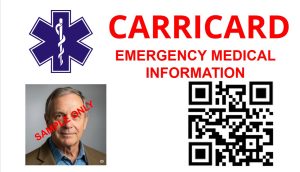
Carricard is a DIY kit that helps you create a physical card — credit card size, fits in your wallet — that includes a QR code linking to a secure webpage you control. In an emergency, first responders scan the code and instantly see your key medical details: allergies, medications, conditions, emergency contacts, insurance details. Whatever you choose to include.
The key word there is you control. No third-party subscription service holding your private data. No monthly fees. No app that stops working when your phone dies. You decide what goes on it, and you can update it any time your details change.
Why Carricard Beats the Other Options
Medical ID bracelets: can break, get lost, or be overlooked. And there is very limited space for the information that actually matters.
Phone apps: as we’ve established, utterly useless if your phone is locked, damaged, missing, or out of battery. Which is usually exactly when you need it.
Third-party subscription services: charge you monthly and store your private medical data on their servers. No thank you.
Carricard: lives in your wallet. The QR code links to as much information as you choose. You own your data. No subscriptions. No hidden fees. Works anywhere in the world. Can be laminated to make it durable and water-resistant. One-time cost of $17.
Seventeen dollars. For lifetime access. Compare that to the cost of confusion in a foreign clinic. It is barely worth the comparison.
What You Actually Get
For that one-time payment, the Carricard kit includes:
- The complete DIY kit as a digital download
- A step-by-step setup guide (plain English, not tech jargon)
- Professional card templates ready to print
- QR code generator instructions
- Guidance for hosting your medical info page
- Lifetime access to updates
You need a standard printer and about 15 minutes. That’s it. If you can print a document and follow basic instructions, you can set this up. It is not techy. It is not complicated. It is genuinely straightforward.
Once it is set up, you are protected every time you leave the house — whether that’s a long-haul flight to Da Nang or a walk to the shops.
What Should Be On Your Card
Keep it simple. Not cluttered, not dramatic. A good card helps a stranger act fast. The Carricard templates are designed around exactly this. Cover the basics:
- Your full name and date of birth
- Emergency contact
- Key medical conditions
- Serious allergies (especially medication allergies)
- Current medication
- Important implanted devices
- Doctor or clinic contact
- Travel insurance details and emergency assistance number
- Preferred language
- Blood type, if confirmed
For international trips, the QR code page can be set up in the local language too. So the card works for both the first responder who speaks English and the nurse who doesn’t.
Where to Keep It
Do not hide it. A medical alert card buried in a zipped pouch is almost useless. Keep one in your wallet. Keep another with your passport. Keep another near your medication.
Think like a stranger. If someone had thirty seconds to help you, where would they look first? Wallet. Passport holder. Medication pouch. Put the card there.
Because you are not carrying it for perfect circumstances. You are carrying it for messy ones.
The Cost of Doing Nothing
The cost of not carrying a medical alert card does not begin in an emergency. It begins earlier. It begins when you pack and think, “I should probably sort that out.” Then you don’t.
Over a week-long trip, the small mental checks stack up. Do I have my phone? Is it charged? Would anyone know about my allergy? What if my bag gets separated from me? What if I cannot speak?
Each thought lasts only seconds. But they add up. By day four, they become part of the trip’s texture. Less spontaneous. Less bold. Less relaxed. You may choose the safer restaurant, not the better one. You may skip the boat trip — not because it is unsafe, but because you feel unprepared.
Fear says: “Avoid it.” Preparation says: “Decide clearly.” That is the difference.
The Trip You Are Already Taking
You do not need to wait for a big adventure. You need this for the trip you are already taking. The weekend city break. The solo beach holiday. The hiking trip. The airport layover.
Medical confusion does not care how serious the trip feels. It does not care whether you packed light, or whether you are young, fit, careful, or experienced. It only cares whether the right information is available.
The real question is not “Will something happen?” You cannot know that.
The real question is: “If something happens, will I be easy to help?”
Without a medical alert card, the answer is weaker than it should be.
Put Peace of Mind In Your Pocket
You carry a passport because borders need proof. You carry a bank card because payment needs access. You carry a charger because phones need power.
Carry a medical alert card because helpers need information.
Carricard is a one-time purchase of $17. It takes fifteen minutes to set up. It fits in your wallet. And once it’s there, it travels with you everywhere — no subscriptions, no faff, no drama.
Put it in your wallet. Add one to your passport holder. Keep one with your medication. Do it before your next trip.
Peace of mind does not need to be heavy.
Sometimes it is just a small card in your pocket.
Get your Carricard kit at carricard.com — one-time payment, instant access.
Stay well. Stay safe. And travel prepared.